
The Cambrian explosion
A little over 500 million years ago, life on earth suddenly changed.
The Cambrian explosion
If you remember your geology - or your David Attenborough documentaries - you’ll remember the Cambrian explosion, a relatively short period in which life on earth changed from single-cell organisms to…crocodiles.
Life dramatically diversified, with most modern life forms appearing in that period.
Life-forms moved from simple-celled to complex bodies with nervous systems, eyes, teeth…
Instead of survival being ‘passive’ the dynamic of predator and prey emerged.
The AI explosion
The Cambrian explosion can be a useful metaphor for the rapid proliferation of new forms of artificial intelligence.
The sudden emergence of powerful, complex new forms of intelligence
Rapid proliferation of AI agents, tools, systems & amp; products
Disruption of existing industries & systems such as Education, Marketing, Professional Services, Legal…
New relationships and dynamics such as AI/human and AI/AI
As almost every organisation evolves and adapts, leaders have a choice: passive adaptation or active experimentation.
Passive adaptation
If you choose to wait and see, your organisation might just be one of the few forms of human intelligence that survive. Algae, bacteria and some other simple life forms have survived from before the Cambrian explosion. Some companies will hang around relatively unchanged – they will be the organisational equivalent of blue-green algae.
Active experimentation
There has never been a better – and more necessary - time to experiment. Whilst the training models, data centres and compute needed to own AI has massive barriers to entry, the ability to use AI and experiment with applications is widely available to all. This is a space in which leaders get the opportunity to lead.
A leader’s mindset
To actively experiment, we need leaders with a mindset which is open, curious and keen to learn. Those characteristics are core features of what Carol Dweck calls Growth Mindset, or what we can call Conscious Leadership.
Conscious leaders choose to stop and think, and to minimize reactivity, blame and drama.
And yet, leaders are uniquely challenged today by the need to survive (read: hit targets, do more-with-less, keep clients happy). It can feel like there isn’t enough time, money or energy to get out of the weeds.
The Strategic Leader
The reality of leadership today – from the diverse leaders we speak to every week - inspired us to reinvent our approach to leadership development.
Right now, organisations need leaders with the right mindset – to actually LEAD – to try new things, to actively learn.
We need leaders who can see the big picture, not just battle through the daily crises.
Flipping the tables
So, we decided to adapt and experiment our approach to leadership development.
We ‘flipped the table’ on traditional leadership programs.
From ‘in the room’ to ‘off the leash’.
From once a year to every day.
From content-focused to application-focused.
And we start the program with a module on applying conscious leadership to be open, curious and learning.
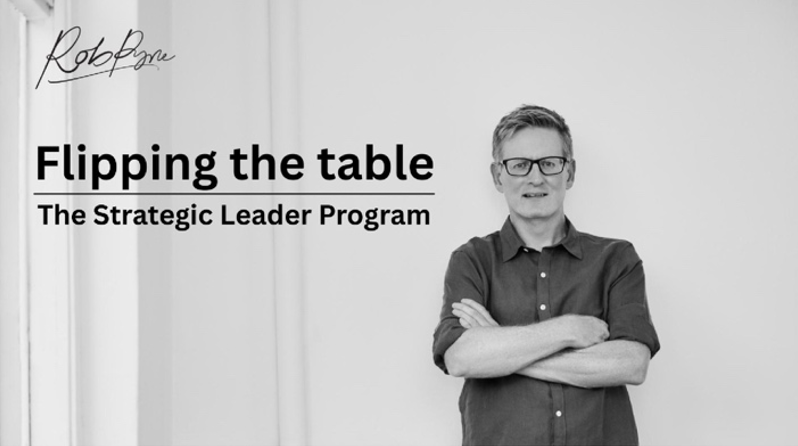
Check out my video on the key ways we have designed this program differently. To support leaders in a new reality, an era of explosion and adaptation.
Or check out the full program overview here:
